- Home
- Bangkok hotels
- Suvarnabhumi Airport
Suvarnabhumi Airport Bangkok
resurrecting the Golden Land
By Eric Lim
Suvarnabhumi Airport, the new Bangkok International Airport, aviation hub and gateway to Thailand was raised from the boggy "nong gu hao" or Cobra Swamp in an effort that took 33 years.
Location of Suvarnabhumi
Located to the south-east of Bangkok in Bang Phli district, Samut Prakarn province, Suvarnabhumi Airport is barely 500 m beyond the Bangkok city limits and about 35 km from the city center.
View Larger Map
Two major highways lead to the airport:
- The Bangkok – Chonburi Motorway to the north of the airport
- Rama IX Road - Bang Na – Trad Highway to the airport from the south.
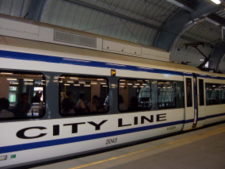
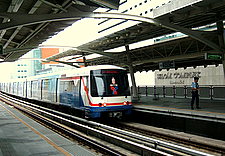
The airport is also linked to the city via the Airport Rail Link.
Historical background to Suvarnabhumi
The name Suvarnabhumi has a long and interesting history, reminiscent of a golden era of peace and prosperity that's part of the cultural and historical legacy of Thailand.
Long before the first Europeans arrived in South-East Asia in the 16th century, the region had close commercial and cultural links with India, a civilization that existed more than 15 centuries ago. This cultural legacy is still evident in Thailand and many South-East Asian countries.
Indian scholars referred to the region east of India and south of China, i.e. Burma, Indo-China and Thailand or mainland South-East Asia, as Suvarnabhumi or the Land of Gold, a word in ancient Sanskrit, (Suvarn is gold in Thai).
The islands of the Malay Archipelago to the south were called Suvarnadvipa or the Islands of Gold.
This was probably because of the rich natural resources in the region which the Europeans were soon to discover. It was no coincidence that the Chinese sea-faring traders had a similar name for the region.
The name Suvarnabhumi (pronounced su-wan-na-poom) or the Golden Land was bestowed on the airport by His Majesty King Bhumipol Adulyadej.
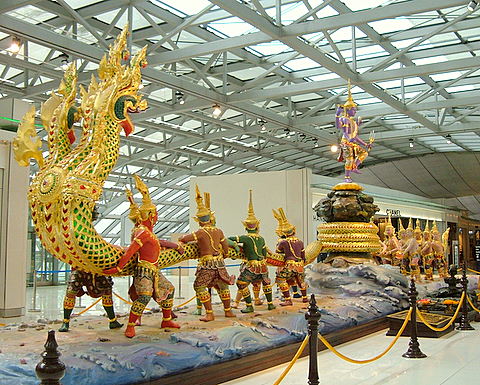
Churning the Ocean of Milk – centrepiece in the departure terminal
The 33 long years
The development of Suvarnabhumi Airport from its inception in 1973 to its completion in 2006 was perpetually dogged by a series of political and financial problems.
Land for the airport was first purchased in 1973 in an area known by the unsavory name of Nong Ngu Hao or Cobra Swamp.
But the 14 October 1973 uprising that overthrew the military dictator Field Marshall Thanom Kittikachorn and the subsequent political turmoil grounded the project for the next 20 years.
Suvarnabhumi Airport was revived in 1996 with the formation of the company New Bangkok International Airport (NBIA), to be stalled by the Asian financial crisis a year later.
It was only in January 2002, that construction actually started. This time the project was plagued by cost overruns, defects and delays in construction.
By early 2005, it was apparent that the September opening date later that year just couldn't be met. In that same year, NBIA was dissolved and its functions transferred to the Airports of Thailand Plc.
A frustrated Prime Minister Taksin Shinawatra actually camped at the airport construction site in an attempt to drive the project on. Allegations of a massive corruption scandal over the airport bomb scanner equipment added to his woes.
Suvarnabhumi – the Golden Land resurrected
In spite of all these problems, Suvarnabhumi Airport by September 2006 is finally completed. The result is an airport complex covering 32 sq km or 8,000 acres!
The passenger terminal, with seven stories, a basement and 360 check-in counters, has a built-in area of more than half a million sq m, just under the combined floor areas of Terminals 1 & 2 at Singapore's Changi International Airport.
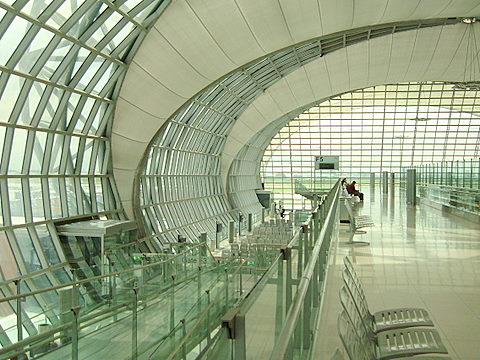
The departure area
With two runways, Suvarnabhumi has a current capacity of 30 m passengers per year, soon to be upgraded to 45 m. The ultimate objective is to add another two runways to boost the capacity to 100m passengers per year.
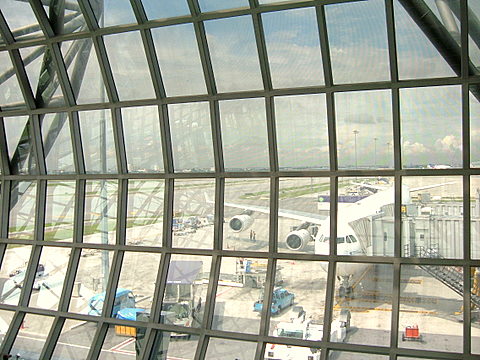
Busy at the parking bay
It also boasts the highest control tower in Asia at 132 m, edging out the 130 m tower in Kuala Lumpur International Airport.
Suvarnabhumi Airport has finally arrived after 33 long and arduous years. This impressive structure is now the new gateway to Thailand, the new Bangkok International Airport and an international aviation hub that's poised to be the pride of Thailand and the aviation world.
Suvanabhumi, the Golden Land has been resurrected, symbolizing the peace and prosperity of an era gone by.
Suvarnabhumi Airport Link
The Airport Rail Link which opened on 23 August 2010 connects Suvarnabhumi Airport to Makkasan and Phaya Thai stations in the city.
Suvarnabhumi Airport hotels.
Several airport hotels have sprouted up in and around Suvarnabhumi, please see Suvarnabhumi hotels.
For the location of these hotels, please see map to the hotels in Suvarnabhumi and Bang Na.
Post opening woes of Suvarnabhumi Airport
Shortly after its opening on 28 September 2006, niggling problems started surfacing in Suvarnabhumi. Slow baggage recovery, flights taking off without luggage, blackouts, poor signage, poor taxi service and insufficient toilets were the common gripes of the initial visitors. If these issues were minor, they were merely a harbinger of worse to come.
The earlier problems paled in comparison to what followed. In late 2006, cracks started appearing in some taxiways and the eastern runway. By early 2007, these cracks were serious to close the runway temporarily while some flights had to be diverted to U Tapao in the east.
To aggravate matters further, some of the passenger boarding bridges were found to be damaged.
It soon became inevitable that good old Don Muang Airport had to be revived to take some of the load off Suvarnabhumi, ease the congestion to facilitate repairs.
Initially domestic flights with no international connections were to be relocated to Don Muang.
On 6 February 2007, the Thai government decided in a cabinet meeting not only to relocate these domestic flights but some international flights as well. Repair work was suspended pending a full scale investigation.
As engineers ponder over the cause and extent of these cracks on the runway in Suvarnabhumi Airport, preparations are underway to prepare Don Muang for reopening.
It's sad that what was meant to be a monument of national pride turned out to be a crying shame.
Suvarnabhumi Airport shuts down!
The unthinkable happened on the afternoon of 25 November 2008. Anti-government protesters stormed into the terminal building of Suvarnabhumi.
Scuffles broke out with airport officials. In the interest of safety of the travelers, the authorities shut down the airport. Thousands of air travelers were stuck.
As the closure dragged on, U-Tapao airbase to the south of Bangkok was activated a few days later. The backlog of stranded passengers grew with the passing days and hit 300,000 within a week.
It was only on 2 December when the Constitutional Court disqualified the government of PM Somchai Wongsawat did the protesters agree to leave the airport.
They vacated Suvarnabhumi at 1000 hours on 3 December. Normalcy gradually returned as we close the saddest chapter in the troubled history of Suvarnbhumi.
The jinx of Nong Ngu Hao (cobra swamp) lives on.
Suvarnabhumi Airport sights
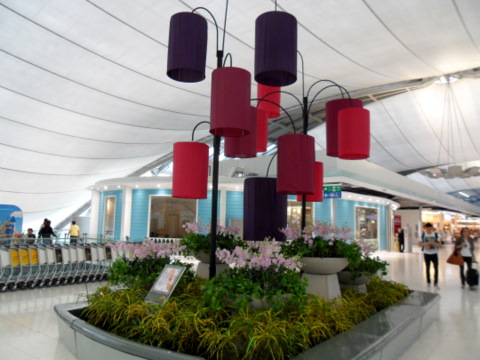
After the depressing news from the last two sections, let’s switch to a lighter note. Since early 2011, I’ve noticed attempts made to soften the hard metallic atmosphere in Suvarnabhumi. Let me share some of these photos with you.
Visitors on entering the departure hall will definitely see this beautiful floral arrangement right in the centre of the hall.
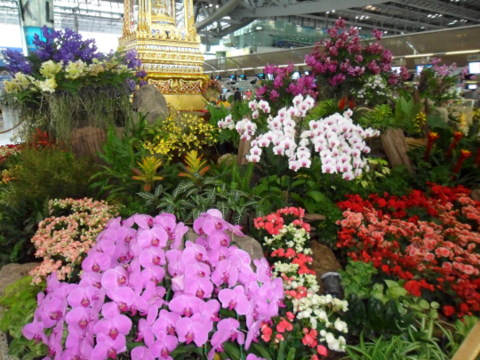
Flowers galore
It’s a favourite photo back drop for many visitors.
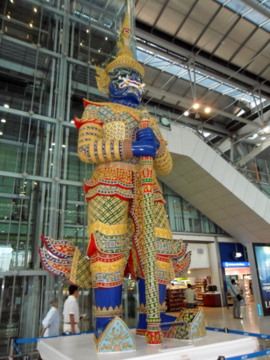
These huge statues are at the rear of the departure hall before you enter the immigration control. They are the giants from the Ramakian masked dance drama which is adapted from the Hindu Ramayana epics.
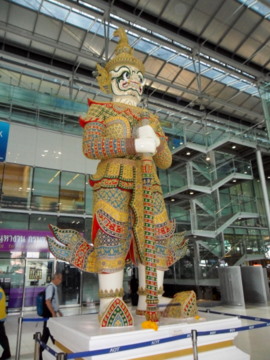
After you have passed the immigration control and the security checks, this is what you’ll encounter. To my mind, it’s the centrepiece of Suvarnabhumi Airport and it’s has been there since 2007.
It’s a huge sculpture of the angels and demons "Churning the Ocean of Milk" to gain immortality, another chapter from the Ramayana epics.
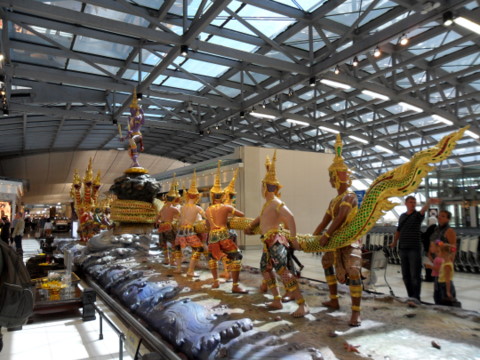
Another view of the spectacle
It’s only after you have gone to your respective departure gates that you may have a chance to view three smaller and very pretty decorative displays, two of which are from northern Thailand.
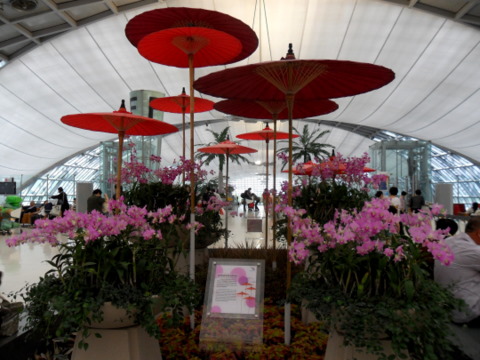
Parasols of Bor Sang, a district in Chiang Mai famous for their hand-made and hand-painted umbrellas
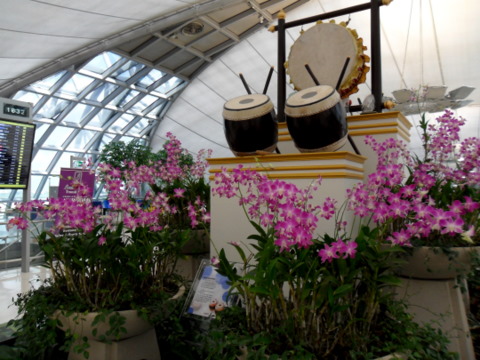
Sabatchai war drums
Yi Peng lanterns of Lanna, northern Thailand are lit and floated to the sky during the Yi Peng lantern festival, on the night of the full moon in the 12th Lunar month which coincides with the Loy Krathong Festival.
Yi Peng lanterns of Lanna
The next time you depart from Suvarnabhumi Airport take some time to enjoy these displays which give insights to Thai culture, handicraft and festivals.
To return to Bangkok Hotels.
My Journey through Thailand Part I The First Steps
This is my second e-book and the first in the series of travel journals on my trips to explore the various provinces in Thailand. This edition, which covers my travels from late 2009 to mid-2013, will guide you to historical sites, cultural monuments and exquisite Thai handicraft, across a vast spectrum of cultural and ethnic diversity.
You can have a virtual tour with this e-guide book or take the first steps yourself in this journey through Thailand.
My Kindle e-book




What's New


-
Prayer for Funding of my Business Venture
Jul 19, 23 04:17 AM
-
Hi from London England.
Oct 15, 22 04:53 AM

Search Tour Bangkok Legacies with DuckDuckGo
Related pages