- Home
- Jim Thompson House
- Thai Silk
Thai silk
the exquisite Thai fabric
By Eric Lim
The lustrous iridescent Thai silk gown glittering in the light and shimmering with varying colors when viewed from different angles adorns the graceful hostess. The handwoven fabric with elaborate patterns is a product of traditional craftsmanship honed through centuries. How did it all start?
The history of silk
The history of silk originated when a silkworm in an overhanging branch in the garden fell into the Chinese Empress' tea.
The silk unraveled and revealed a new opportunity that was jealously protected in China for thousands of years.
Intermarriage between a Chinese princess and an Indian Prince in 1st century AD resulted in the silkworm being smuggled out of China. Consequently, silk flourished in India and later spread to Thailand.
There are varying qualities of Thai silk which comes in brilliant colors, two tone colors, fabric with luster and sheen, each piece handwoven and an individual work of art. The finest pieces are brocaded with gold and silver threads in intricate patterns.
The Thai silk production process
The process of growing the silkworm, which is a caterpillar and not a worm, is done in the northeast region of Thailand. The process of weaving is mostly done in the northern region.
The silk thread is made from the filament spun from the salivary glands of the silkworm that feeds on the mulberry tree.
As the silkworms grow, their bodies are filled with raw liquid silk. They spin a cocoon with the liquid which hardens on contact with air. Thread from one cocoon is about 500 – 1500 m long.
Cocoons are boiled to extract the thread and several filaments are combined to form a stronger fiber.
The process involves extraction, bleaching, washing and dying. Traditionally, the thread is wound around spools for weaving by hand not machine.
Originally, barks and leaves were used for dyes. These dyes were not permanent and run after several washes. Later chemical dyes, which were more permanent, were introduced.
Where the Jim Thompson raw silk comes from
The 96 hectare (240 acres) Jim Thompson Farm is in Pak Thong Chai in Nakhon Ratchasima (Korat) province in north-east Thailand (about three hours drive from Bangkok).
Established in 1988, Pak Thong Chai farm is in the district with a long tradition for silk production.
The farm grows mulberry trees, the leaves which silk worms feed on. The silk worms produce cocoons from which the silk is extracted.
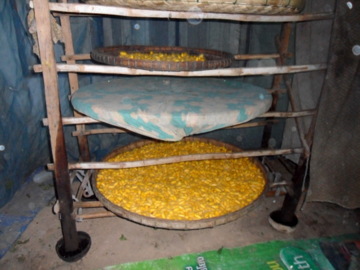
Cocoons of the silk worms
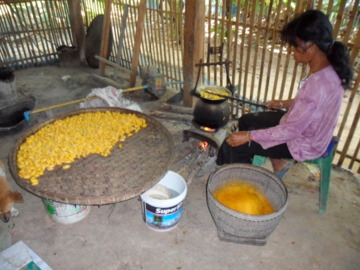
Boiling the cocoons and extracting the silk
Later the Jim Thompson Company found it more cost effective to outsource this process to locals to feed silk worms and then buy the cocoons from the locals.
This has resulted in a local industry supported by some 2,000 families located primarily in the north-east region with some in the central region.
By cross breeding local moths with species from Japan and China, productivity improved tremendously.
The cross-bred specimens produce thicker cocoons which reel out 1,200 meters of thread, a 50 % increase over the local variety.
Other interesting facts and figures on silk production are:
- it takes 380 cocoons to produce 90 grams of silk yarn,
- A woman's dress requires 650 cocoons to produce the necessary silk yarn,
- A necktie takes about 120 cocoons.
The silkworm pupae, the portions that are removed when the cocoons are boiled, are a delicacy with silkworm farmers. Some have even been canned and sold. Fancy some?
Weaving Thai silk
In the post-World War II years, Jim Thompson was instrumental in reviving the local silk industry in the face of competition from mass produced synthetic materials.
The Jim Thompson Thai Silk Company has a weaving factory 20 km south Korat about 200 km north east of Bangkok that's the biggest in the world.
Today the company has branches and distributors in the major fashion capitals of the world.
The Jim Thompson Farm in Pak Thong Chai provides a reliable and high quality supply of raw silk.
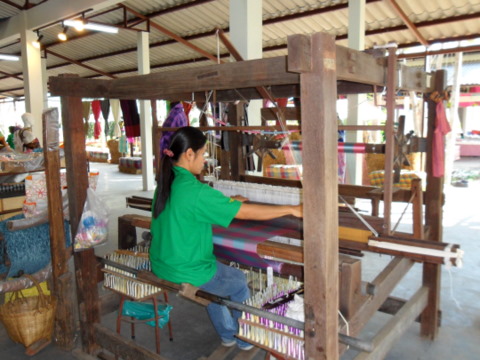
Silk weaving at the Jim Thompson Farm
These silk fabrics can be viewed at the various Jim Thompson outlets in Bangkok.
The Thai silk industry today though organized under modern industrial management still retains the artistry and skill acquired through generations of traditional Thai craftsmanship.
Besides the Jim Thompson silk, there are numerous individual silk weavers in north-eastern Thailand working from their farms and homes. Each area produces silk with their distinct characteristics.
Here are samples of the exquisite Phrae Wa Thai silk from Ban Phon, Kalasin.
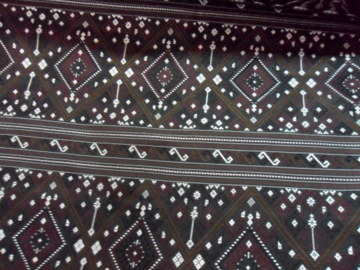
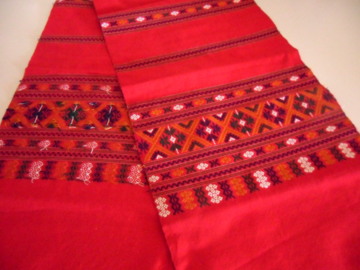
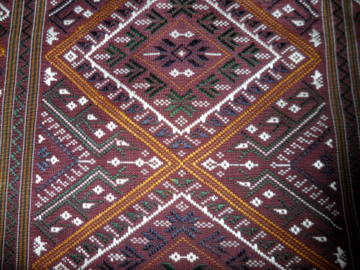
Phrae Wa Thai silk, Ban Phon, Kalasin
To return to the Jim Thompson House.
Related page
Tour Bangkok Legacies – my first e-book
If you are an independent traveller, here's a handy e-guide book, Tour Bangkok Legacies, which will help you along as you explore the streets of Bangkok and discover its old treasures. It's complete with historical descriptions, maps and detailed directions on how to get to these places.
My Kindle e-book



What's New


-
Prayer for Funding of my Business Venture
Jul 19, 23 04:17 AM
-
Hi from London England.
Oct 15, 22 04:53 AM

Search Tour Bangkok Legacies with DuckDuckGo
Related pages
Jim Thompson outlets in Bangkok

My Journey through Thailand
Part I The First Steps
My Kindle edition

My Smashwords edition

Tour Bangkok Legacies
new discoveries of old treasures
My Kindle edition
My Smashwords edition