- Home
- Bangkok Churches
- Holy Rosary Church
Holy Rosary Church
crown of roses on the
Chao Phraya
By Eric Lim
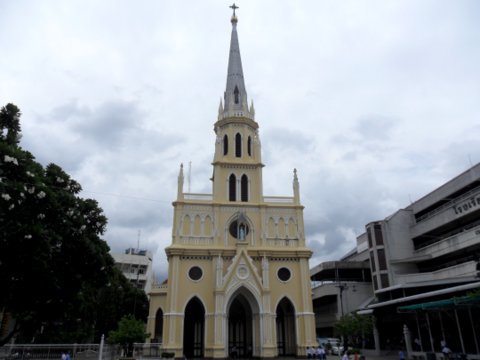
The Portuguese built Holy Rosary Church, an old Bangkok church, in 1786 with a land grant from King Rama I, four years after Bangkok was established as the capital.
Like the Santa Cruz Church, it's by the Chao Phraya, this time on the Bangkok bank. Like the Santa Cruz Church, it was the Portuguese descendants of the early traders in Ayutthaya who founded this church.
Originally based in Santa Cruz Church in Kudi Jeen Thonburi, the Portuguese felt the need for a separate church after the entry of the French clergy.
The result of this rift was the start of Holy Rosary Church in Samphanthawong on the Bangkok bank of the Chao Phraya just south of Yaowarat, Chinatown.
The Thai name for this Catholic church was originally Kalawario, a Thai transliteration of Calvary, the mount on which Jesus Christ was crucified. The name was later changed to Kalawar.
Rosary, the name in English is derived from "rosarium", Latin for rose garden. Hence "kularb" or rose in Thai in the names of the schools affiliated to the church.
The word Rosary means "Crown of Roses". Our Lady has revealed to several people that each time they say a Hail Mary they are giving her a beautiful rose and that each complete Rosary makes her a crown of roses. The rose is the queen of flowers, and so the Rosary is the rose of all devotions and it is therefore the most important one.
The Holy Rosary
Having gone through two rebuilding programs in its history, the present church is the result of the third rebuilding from 1891 – 1898.
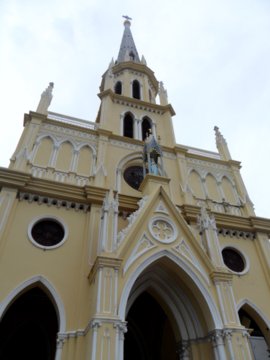
The present cream-colored structure has a high facade topped with a towering spire; a statue of Virgin Mary stands above the high arches framing the main entrance, leading to tall arched doors.
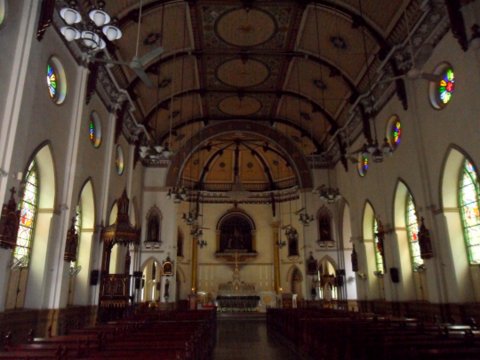
The beautiful interior
Walled in from the bustling exterior, the Holy Rosary Church is flanked by the Kularb Wattana School and the Kulab Wittaya School, with a little courtyard converted to a games court facing the Chao Phraya River.
Like many of the Bangkok churches, this design creates a cloistered environment for religion and study temporarily shutting out the city outside.
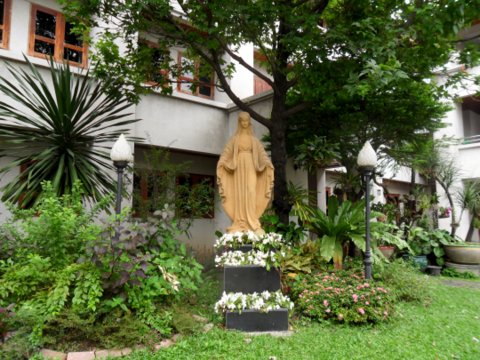
A statue of the Virgin Mary stands in the little garden in the Sisters' quarters next to the main church building. A Crucifix is on the outer wall of the quarters.
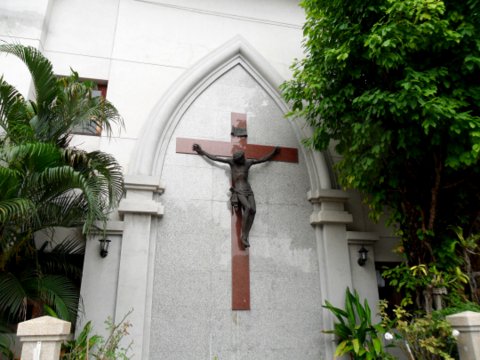
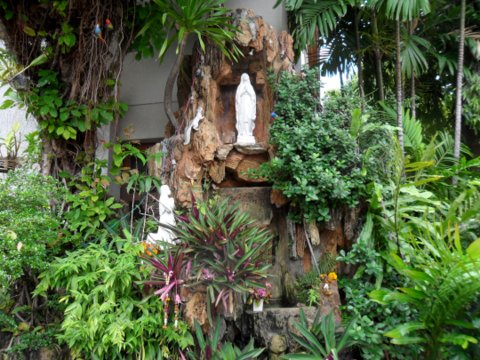
A beautiful rock garden at the corner with another statue of the Virgin Mary completes the scene of peace and tranquility.
As her power and influence overseas diminished over the years, Portugal was soon eclipsed by the other European powers. Nonetheless this old Bangkok church and Santa Cruz Church are reminders of a small seafaring nation who were the first Europeans to venture into Asia.
The Holy Rosary Church is conveniently located in a pedestrian mall along the riverbanks leading from River City Centre through to Chinatown.
Map to the Holy Rosary Church
View Larger Map
How to get there
By BTS Sky train
Take the Green Line (BTS Sky Train) to S6 Saphan Taksin Station. Then take a Chao Phraya river boat from the Sathorn Pier to N3 Si Phraya Pier. From the pier it's about a 350 m walk to the church.
Antique lovers can view the antique collection at the shops in the River City Centre near the Si Phraya Pier. Chao Phraya River cruises can also be booked at the River City.
By car
If you're driving there, go along Charoen Krung Road past the Si Phraya junction, take the left fork, cross the bridge and turn left at Yotha Road.
The local name for the church as shown on signboards is Kalawar Church (a Thai transliteration of Calvary).
Read about more Bangkok churches.
My Journey through Thailand Part I The First Steps
This is my second e-book and the first in the series of travel journals on my trips to explore the various provinces in Thailand. This edition, which covers my travels from late 2009 to mid-2013, will guide you to historical sites, cultural monuments and exquisite Thai handicraft, across a vast spectrum of cultural and ethnic diversity.
You can have a virtual tour with this e-guide book or take the first steps yourself in this journey through Thailand.
My Kindle e-book

What's New


-
Prayer for Funding of my Business Venture
Jul 19, 23 04:17 AM
-
Hi from London England.
Oct 15, 22 04:53 AM