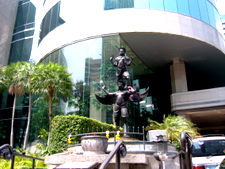
- Home
- Bangkok Shrines
Bangkok Shrines
the legends and faiths of centuries
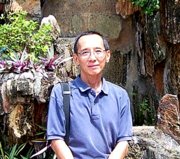
By Eric Lim
Bangkok Shrines reflect a rich variety of deities, Brahma, Ganesha, Kuan Yin, Kuan Yu dating back for centuries, a legacy of the Indian scholars who introduced Buddhism to Thailand and early Chinese immigrants.
The worship of these deities is inextricably linked with the practice of Buddhism in everyday life.
The reputation of some of these shrines has even drawn foreign worshippers to the city.
Hindu Shrines
The highest concentration of shrines dedicated to Hindu gods and a goddess is around the Ratchaprasong junction. Each commercial building has a deity as its guardian and patron saint.
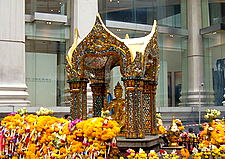
Of all the Bangkok shrines, the most popular among Thais and foreigners is the Erawan Shrine a shrine visited by hundreds everyday. The shrine has a gripping legend that deeply influenced the fate and name of the hotel behind it, the Grand Hyatt Erawan Hotel.
Were your prayers answered at the Erawan Shrine? Tell us your story
Read the stories of others who had their prayers answered
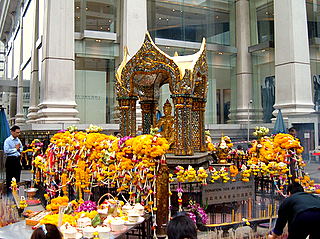
The famous "four-faced Buddha"
For the location of these Hindu shrines, please see map of the Bangkok Shrines at Ratchaprasong
Commonly called the four-faced Buddha the shrine is actually a four-faced statue of Brahma, one of the Trinity of Hindu Gods.
Erawan is, in fact, the name of Indra's three-headed elephant!
The aura of Erawan is so strong that the boutique shopping mall nearby that opened in November 2004, adopted the name Erawan Bangkok.
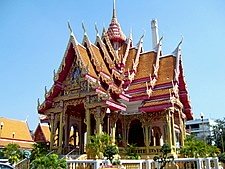
Another popular shrine with the locals is the Trimurti Shrine across the road in front of Central World Plaza. Trimurti refers to the Trinity of Hindu gods, Brahma, Vishnu and Siva.
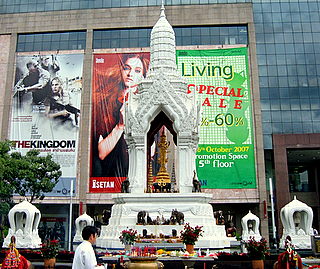
The Trinity of Gods
The Trimurti Shrine is one of the Bangkok Shrines with a very romantic allure.Called the Lovers' Shrine, many believe that those who pray here for true love will have their dreams fulfilled.
Located next to the Trimurti Shrine is the Ganesha Shrine dedicated to Ganesha, the son of Siva who severed his son's head in a fit of rage.
The deity has an elephant head and a human form.
The Elephant God of accomplishment, success, wisdom and wealth attracts many worshippers.
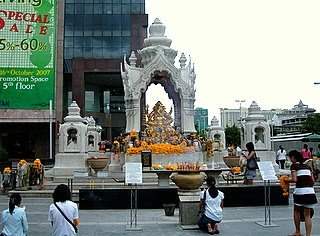
The Elephant God
Across the road in Gaysorn Plaza, a luxury shopping mall, is the Lakshmi Shrine a shrine dedicated to the Hindu goddess Lakshmi, the goddess of wealth, beauty and prosperity.
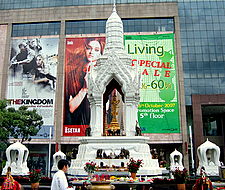
At the entrance to the Intercontinental Hotel, just next to Gaysorn Plaza, the Vishnu Shrine honors the Hindu god Vishnu, the protector of life, the preserver of the universe and the consort of Lakshmi.
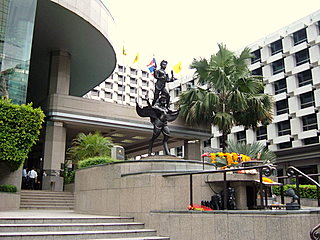
The Vishnu Shrine outside the Intercontinental Siam
Opposite the Intercontinental Siam is the last of the Hindu gods around Ratchaprasong junction.
This is the Indra Shrine, for the supreme god of Hinduism Indra, the god of thunder and rain, the god of war and the deity for Amarin Plaza.
This completes the Hindu Shrines around Ratchaprasong.

Indra the God of War
Location of Hindu shrines at Ratchaprasong
View Bangkok Shrines in a larger map
Chinese Shrines
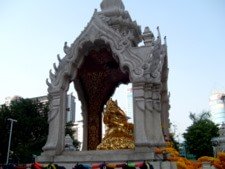
Besides the Hindus, the Chinese also had profound influence on a number of shrines in Bangkok. One of the most famous is the Kuan Yin Shrine built by the Chinese community on the Chao Phraya River in the reign of King Rama III (1824 – 1851).
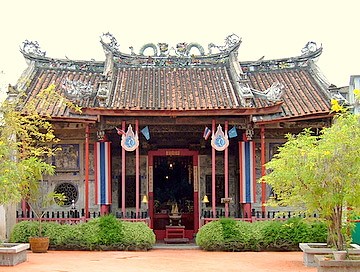
Kuan Yin Shrine
The shrine is dedicated to the legendary Kuan Yin, the ancient Chinese goddess of mercy dating back to 300 B.C. Kuan Yin embodies the virtues of love, kindness, compassion and forgiveness.
The goddess of mercy is a patron saint and savior of the sick and destitute and a protector of sailors and fishermen.
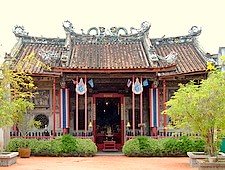
Further downriver is another old Chinese shrine, the Kuan Yu Shrine in memory of Kuan Yu, the God of War, an ancient Chinese general renowned for his courage, loyalty and integrity, a guardian and protector of the realm.
Despite his military prowess, he was also deeply religious and sought the way of peace and righteousness.
A very unusual Bangkok shrine, that's not dedicated to a god or deity but to a legendary female ghost, is the Mae Nak Shrine in Wat Mahabut in Phra Khanong district.
The various Bangkok Shrines provide a spiritual path for those who seek the fulfillment of their hopes and aspirations in a social milieu that's a rich fusion of faiths and cultural diversity.
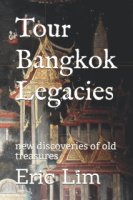
Tour Bangkok Legacies – my first e-book
If you are an independent traveller, here's a handy e-guide book, Tour Bangkok Legacies, which will help you along as you explore the streets of Bangkok and discover its old treasures. It's complete with historical descriptions, maps and detailed directions on how to get to these places.
My Kindle edition
Tour Bangkok Legacies - Kindle paperback edition
For those who prefer reading printed books rather than e-books, here's the paperback edition of Tour Bangkok Legacies, which will help you along as you explore the streets of Bangkok and discover its old treasures. It's complete with historical descriptions and directions on how to get to these places.
My Kindle paperback edition

What's New


-
Prayer for Funding of my Business Venture
Jul 19, 23 04:17 AM
-
Hi from London England.
Oct 15, 22 04:53 AM

Search Tour Bangkok Legacies with DuckDuckGo
Erawan Shrine
Were your prayers answered?
Ganesha Shrine
Kuan Yin Shrine
Kuan Yu Shrine
Lakshmi Shrine
Mae Nak Shrine
Trimurti Shrine
Vishnu Shrine